- /
- News
- /
- Understanding Pre-Prep vs Primary School: What Parents Need to Know
Understanding Pre-Prep vs Primary School: What Parents Need to Know
When choosing the right early years setting for your child, it helps to understand how different phases of education nurture development, confidence and a love of learning. At its heart, Pre-Prep (such as that at Grimsdell, Mill Hill Pre-Prep) provides a distinct start to schooling that supports young children’s growth in ways that are both broad and deeply formative. Here’s how Pre-Prep compares to more traditional primary education and what parents should consider.
Early Starting Points
Pre-Prep typically caters for children from age 3 to 7, covering nursery, reception and Key Stage 1. This is a time when children are establishing the building blocks of formal learning, social confidence and independence. In contrast, primary school in the UK generally runs from ages 5 to 11 (Reception through Year 6), taking children through to Key Stage 2.
Pre-Prep therefore focuses on the earliest phase of a child’s educational journey and bridges the transition from early years settings into more structured schooling.
“Every child deserves the best possible start in life and the support that enables them to fulfil their potential.” - Department for Education, Early Years Foundation Stage Framework
Playful but Purposeful Learning
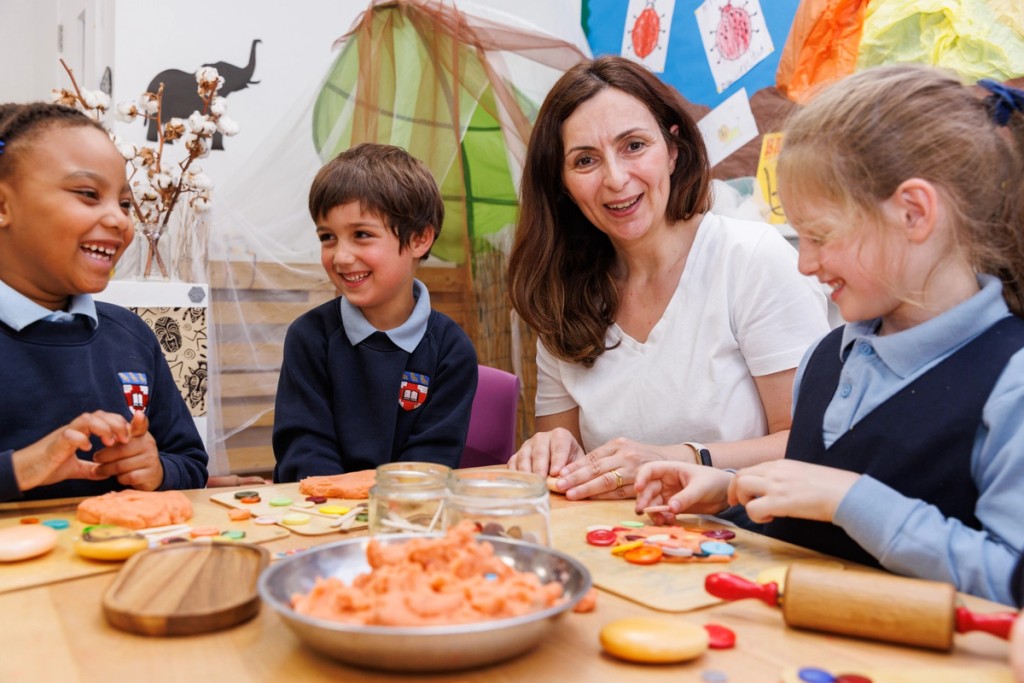
One of the key features of Pre-Prep is its creative and engaging curriculum, designed to ignite enthusiasm for learning without the pressures associated with later primary assessments. At Grimsdell, children experience a rich and diverse curriculum that goes beyond the National Curriculum, blending academic learning with playful, real-world exploration. Fundamental subjects such as reading, writing and maths are taught alongside specialist activities like Forest School, art, music and physical education. This approach helps children form a deep and natural love of learning that stays with them as they progress.
Primary school builds on this foundation by introducing more formalised learning across a wider range of subjects. While still nurturing, the emphasis gradually shifts towards preparing children for national assessments and developing academic resilience over time.
“Play is essential for children’s development, building their confidence as they learn to explore, think about problems and relate to others.”- Department for Education, Early Years Foundation Stage Framework
Social and Emotional Development
In Pre-Prep, there is a strong emphasis on social skills, adaptability and emotional intelligence. Young learners are encouraged to work and play together, make friends, and understand themselves and others. Schools like Grimsdell actively teach a positive mindset, helping children embrace challenge and learn from mistakes, essential life skills at this early stage.
Primary education continues to build these competencies but within a broader age range. As children grow older, friendships become more complex and opportunities for collaboration and leadership expand, reflecting their increasing maturity and capabilities.
“A strong foundation in the early years is crucial to children’s success.” - Ofsted
Outdoor and Specialist Learning
Many Pre-Prep settings, including Grimsdell, place significant value on outdoor and experiential learning. Forest School, free-flow outdoor play and nature-based activities are embedded in daily routines, recognising that children often thrive when learning is connected to the environment.
In primary schools, outdoor learning remains important but is often balanced with more classroom-based work as children move into higher key stages. Specialist subjects such as languages, science, computing and more structured physical education also become more prominent, preparing pupils for the wider curriculum requirements of later years.
Smooth Transitions and Continuity
A key advantage of starting in Pre-Prep is the seamless transition to the next phase of schooling. At Grimsdell, the curriculum and learning approaches are closely linked with the next stage (Belmont Prep), meaning children build on their early experiences without disruption. This continuity supports confidence, reduces anxiety around school moves and helps sustain the momentum of learning.
Primary school itself continues this progression, with structured support to ensure that pupils are ready for secondary education by age 11.
Choosing What’s Right for Your Child
In essence, Pre-Prep provides a nurturing, broad-based introduction to formal learning, focused on joy, curiosity and foundational skills. Primary school builds on this with progressively deeper academic content, greater independence and preparation for later assessments and life beyond school.
For parents, the choice between Pre-Prep and primary contexts comes down to what aligns best with their child’s needs at each stage, whether that’s a play-centred first step into structured learning or the next phase of intellectual and personal development as they grow older.